
René Magritte: Seeing Beyond What Is Seen
There are moments in art when something familiar pauses—just long enough for us to notice it differently. The work of René Magritte lives in that pause. His paintings quietly hold your attention. You recognise what you’re looking at almost instantly—and then, just as quickly, you begin to question it.
At first, his world feels simple. A pipe. A man in a suit. A curtain. A sky filled with soft clouds. Nothing seems exaggerated or dramatic. But the longer you stay, the more something feels slightly off. Magritte doesn’t distort reality in obvious ways. He shifts it—gently, almost politely—and in doing so, he changes how we look at things we thought we understood.
One of the most interesting things about Magritte is his choice of objects. He keeps returning to the same ones—bowler hats, apples, windows, stones, clouds. These aren’t decorative choices; they’re familiar anchors. We trust them because we know them.
But then he changes their context.
A man becomes many men.
A face disappears behind an apple.
A rock floats in the sky.
In Golconda, for instance, the sky is filled with identical men in coats and bowler hats, suspended in space. They don’t seem to be falling or flying—they’re just… there. The repetition is strangely calming at first, almost rhythmic. But then it becomes unsettling. Each figure looks the same, yet they don’t connect. It feels like a quiet comment on identity, and isolation—without ever stating it directly.
Magritte was associated with Surrealism, but his work feels different from what we usually imagine Surrealism to be. There are no melting forms or chaotic dreamscapes. Instead, everything looks clear, almost real. The strangeness comes not from how things look, but from how they behave.
Colour plays a subtle but important role in this. His palettes are often restrained—soft blues, muted greens, gentle greys. Nothing feels loud or excessive. And this restraint matters. When colour doesn’t demand attention, the idea does.
This connects closely with the thinking behind limited colour palettes: when you reduce visual noise, you begin to see structure and meaning more clearly. Magritte seems to understand this deeply. His skies are calm, his tones balanced, his surfaces steady—so that when something unusual happens, it lands with quiet clarity.
You can see this beautifully in The False Mirror. It’s a large eye, filling the canvas. But instead of a typical iris, you see a bright sky with clouds. It’s striking, but also strangely still. The eye—which we trust to see the world—becomes a surface that holds it. It makes you pause and wonder: are we looking out, or looking in?
That same questioning appears in The Treachery of Images. A pipe is painted clearly, almost plainly. Below it, the words read: “This is not a pipe.”
At first, it feels like a contradiction. But then it settles. Of course it isn’t a pipe—it’s just an image of one. You can’t hold it, use it, or interact with it. Magritte gently reminds us of something we usually overlook: images are not reality, even when they look like it.
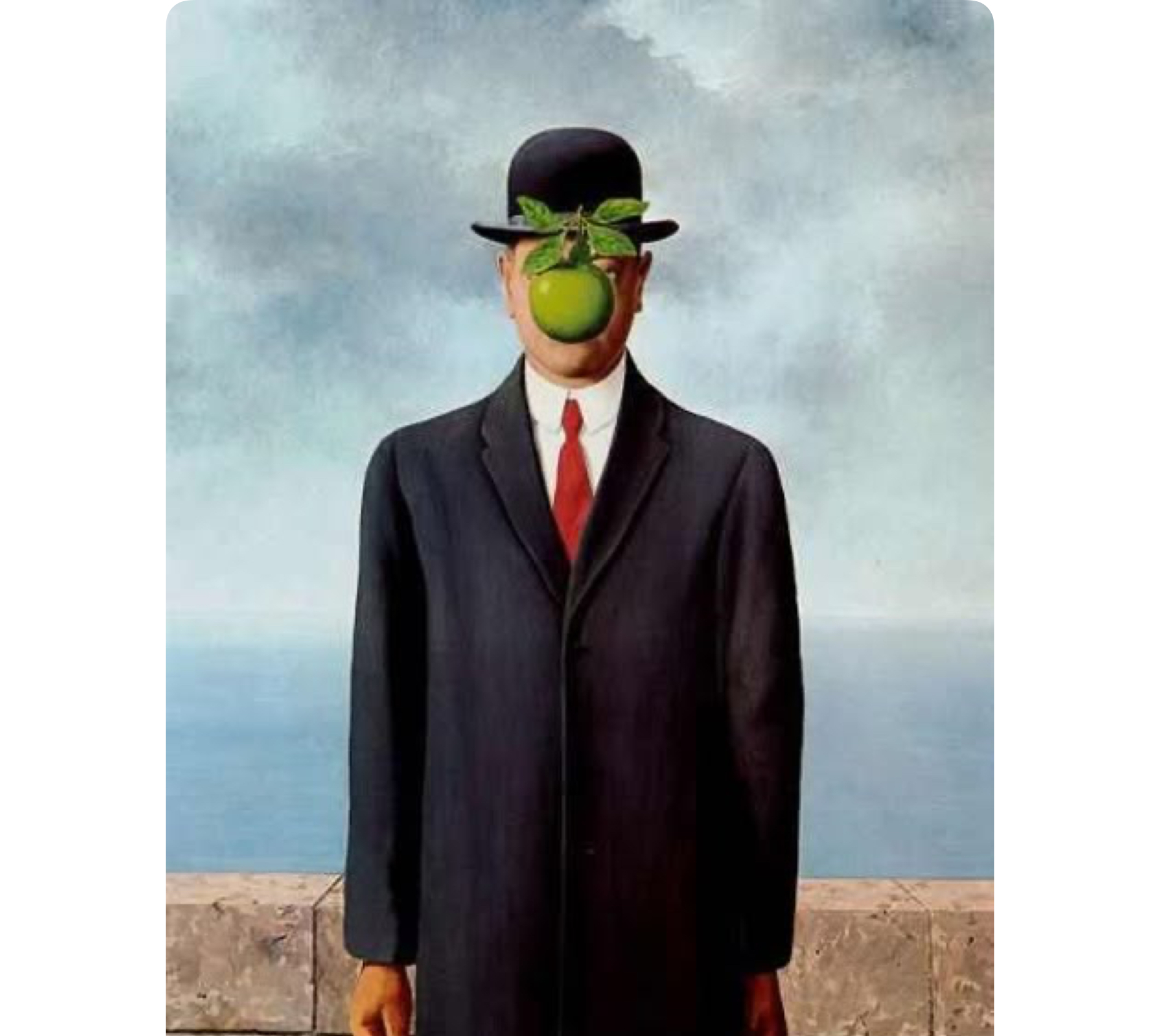
In The Son of Man, a man stands facing us, his face hidden behind a floating green apple. It’s a simple gesture, but it lingers. We instinctively want to see his face, to complete the image. But Magritte doesn’t allow that. He leaves the moment unresolved.
And in that small act of concealment,—we become aware of our own need to see, to know, to complete.
This idea carries into The Human Condition, where a painting placed in front of a window blends perfectly with the landscape outside. There’s no clear boundary between the real and the represented. It all feels continuous.
And it leaves you with a quiet question: when we look at something, are we seeing the world—or just a version of it?
Magritte’s work often feels less like storytelling and more like thinking—visual thoughts, placed carefully on canvas. His background in advertising perhaps contributed to this clarity. His images are direct and readable, but they don’t resolve into a single meaning. They stay open.
There are also traces of his personal life that seem to echo through his work—especially in the recurring idea of concealment. While interpretations vary, these elements add a certain emotional depth beneath the calm surface. Nothing is explained, but something is always felt.
Not everyone responded to his work in the same way. Some critics found it too literal, too dependent on visual ideas rather than painterly expression. Others felt that once you understood the concept, the image lost its tension.
But perhaps that simplicity is the point.
Magritte was not trying to impress through complexity. He was refining how we see. The repetition of objects, the restraint in colour, the clarity of composition—these are all choices that bring the idea forward, without distraction.
In today’s image-heavy world, his work feels especially relevant. We are constantly surrounded by visuals, often accepting them without question. Magritte slows that process down. He creates a small gap between seeing and understanding.
And that gap matters. For artists and designers, there’s something valuable here.
Engaging with René Magritte is less about finding answers and more about noticing. His paintings change the way how you look.And once that shift happens, even slightly, it stays with you.
The ordinary begins to feel a little less certain. The visible, a little less obvious.
And perhaps that is where his work continues to live—in that quiet, thoughtful space between what we see and what we understand.