

The Quiet Lineage of Rural Life
Standing inside the Van Gogh Museum, I found myself unexpectedly lingering before the works of Léon Augustin Lhermitte.
His name appeared repeatedly in Vincent van Gogh’s letters to Theo — with deep admiration, almost reverence.
It immediately raised a question:
What did Van Gogh see in Lhermitte that moved him so profoundly?
The answer begins in the fields....
Léon Augustin Lhermitte and Vincent van Gogh shared more than admiration across distance — they shared a profound respect for ordinary people, especially those shaped by labor, land, and rural life.
In the vast history of art, influence is often imagined as dramatic — bold manifestos, direct mentorships, or revolutionary movements. Yet some artistic relationships are quieter, built through admiration from afar. The connection between Léon Augustin Lhermitte and Vincent van Gogh belongs to this quieter category: a dialogue carried through paintings, letters, and shared devotion to rural humanity.
Van Gogh never formally studied under Lhermitte, but he deeply revered him. In letters to Theo, Van Gogh repeatedly praised Lhermitte’s ability to portray peasant life with dignity and truth. For Van Gogh, Lhermitte wasn’t merely a skilled painter; he was one of the few contemporary artists who truly understood the soul of labor.
At a time when industrialization was rapidly changing Europe, both artists turned their attention toward the countryside. But unlike romanticized pastoral imagery, their works focused on labor itself — haymakers bent beneath the sun, sowers crossing fields, women gathering crops, workers resting after exhaustion.
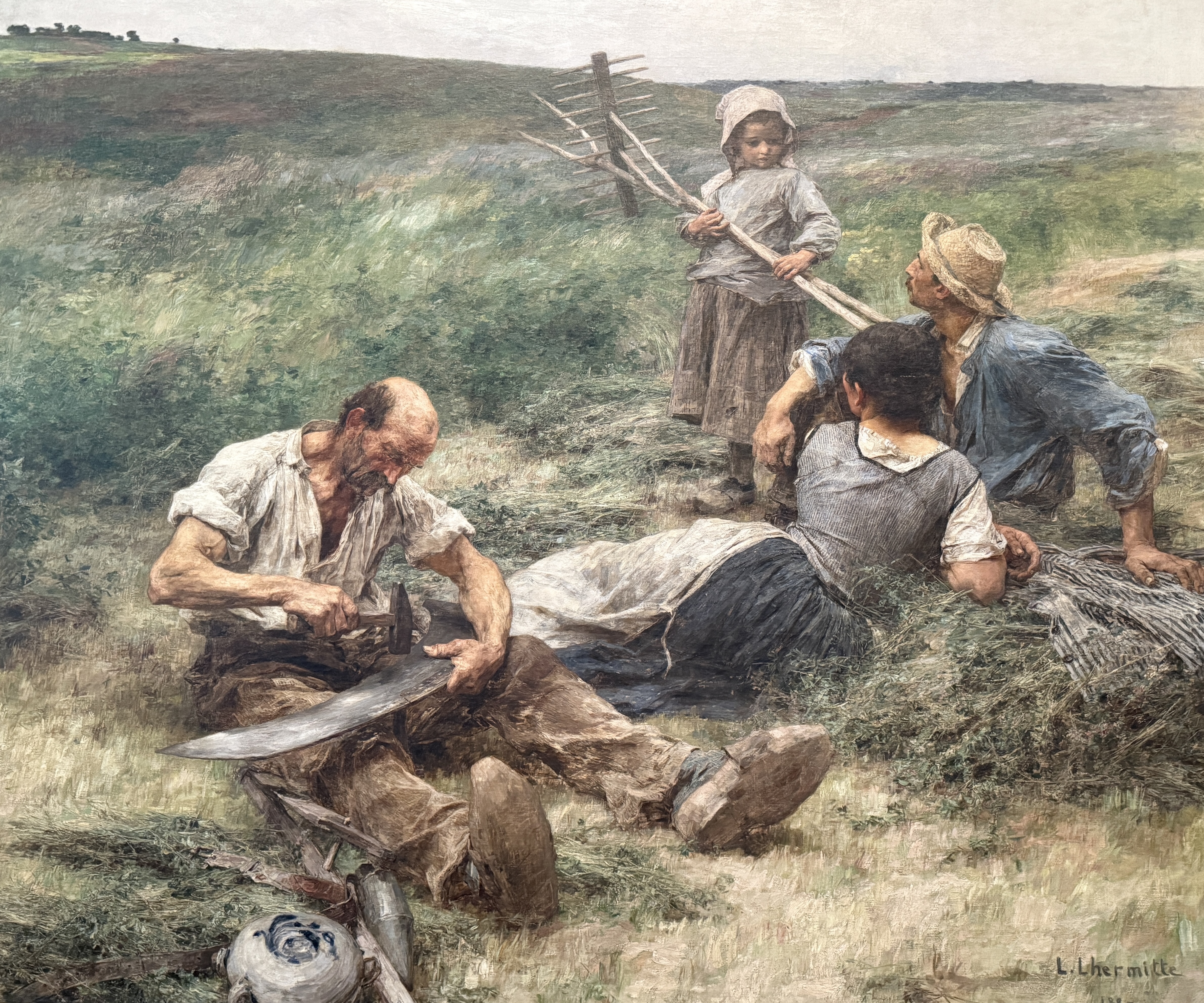
Lhermitte approached these scenes with Naturalist precision. His paintings observed rural life carefully, almost ethnographically, yet never coldly. Works such as Haymaking transformed agricultural labor into something monumental. The figures are grounded, weary, and deeply human. Light spills across the fields as — soft, patient, and lived-in atmosphere.
Van Gogh responded intensely to this sincerity. Before the explosive color and expressive brushwork of Arles, Van Gogh spent years studying peasant life. He believed modern art had neglected workers and farmers — the people most connected to the rhythms of existence. Lhermitte’s paintings validated this pursuit.
In many ways, Van Gogh’s famous peasants descend spiritually from Lhermitte’s world.
The relationship between the two artists wasn’t a stylistic imitation. Lhermitte remained rooted in realism and naturalism, while Van Gogh moved toward emotional intensity and expressive color. Yet beneath their visual differences lies a shared philosophy: ordinary lives deserve grandeur.
Van Gogh admired how Lhermitte painted workers without sentimentality. There is exhaustion in these paintings, but never pity. The figures possess weight, permanence, and quiet resilience.
This influence can be felt strongly in Van Gogh’s early works, particularly *The Potato Eaters* , * his many drawings of sowers and reapers, * and later harvest paintings from Arles.
Van Gogh once wrote that Lhermitte painted peasants “as if carved from the earth itself.” That admiration reveals something essential about Van Gogh’s own artistic search. He was not simply searching for beauty; he was searching for truth embedded in everyday existence.
The theme of haymaking becomes especially meaningful when comparing the two artists. Haymaking is repetitive, seasonal, physically demanding work. Yet both painters transformed it into visual poetry.
For Lhermitte, hayfields became spaces of social observation and collective labor. His compositions often contain groups of workers whose bodies create rhythms across the landscape.
For Van Gogh, fields became emotional landscapes. Wheat, hay, and harvests carried symbolic meanings — cycles of life, mortality, endurance, and renewal.
One painted the social reality of rural life; the other painted its emotional resonance.
Another striking parallel lies in how both artists integrated figures into nature. Their peasants are never decorative additions. Human beings belong to the land physically and spiritually.
Lhermitte’s workers often appear solid and sculptural, emerging naturally from the earth tones around them. Van Gogh intensified this connection through dynamic brushwork and vibrating color, making fields seem alive with energy. Despite stylistic differences, both artists rejected the growing distance between urban modernity and rural existence.
Today, Van Gogh’s fame eclipses Lhermitte’s, yet revisiting their connection reveals how artistic influence often operates through shared values rather than shared techniques. Lhermitte gave rural workers visibility without romantic fantasy, while Van Gogh carried that vision into emotional modernism. Together, they created some of the most compassionate representations of working people in nineteenth-century art.
And perhaps that is why their paintings still resonate today — not because they depict grand historical events, but because they honor ordinary human endurance beneath open skies.