

Looking at Mountains: A Study in Seeing
My recent trips to Switzerland and Himachal made me look at mountains in a slightly different way.
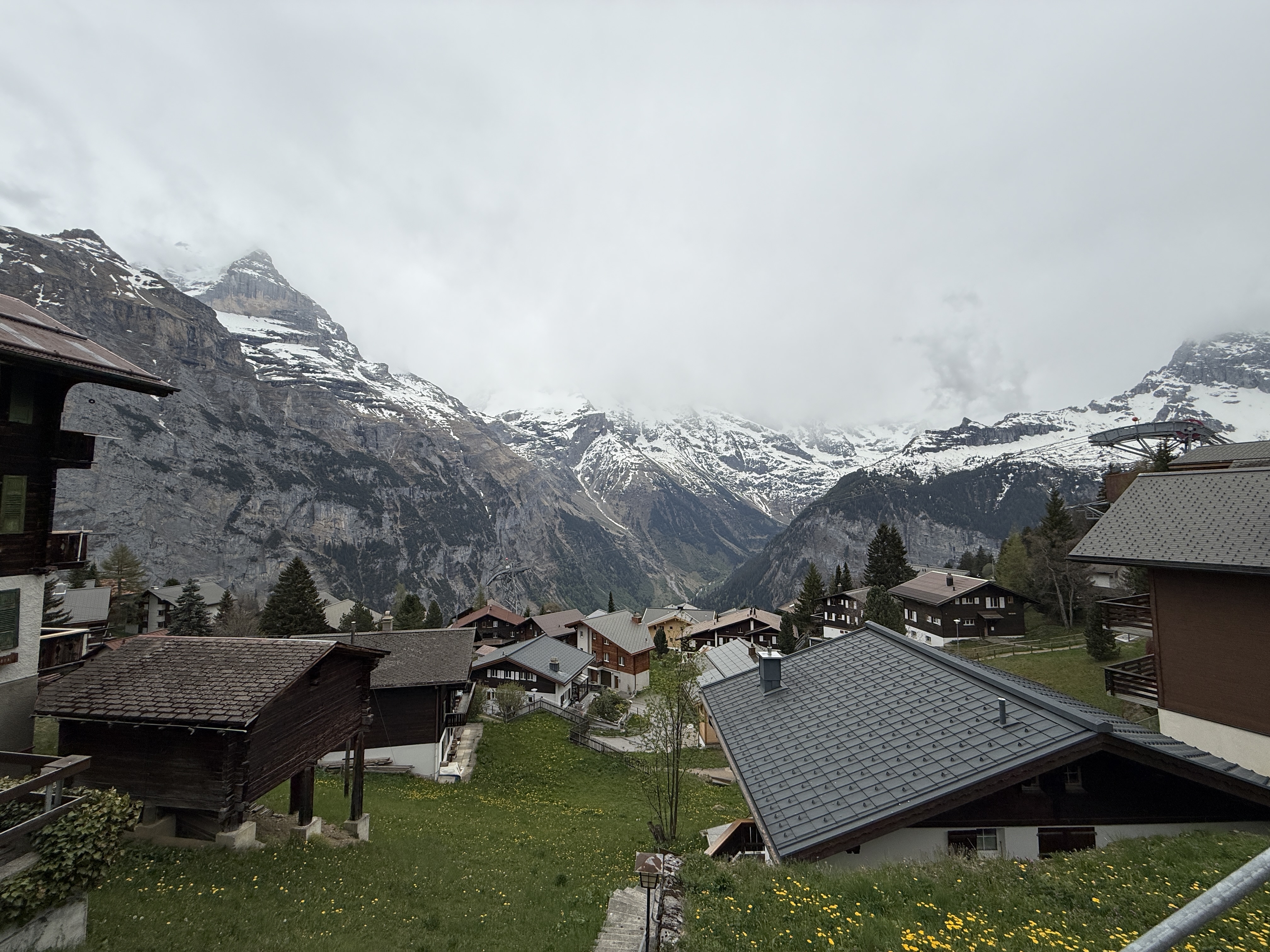
I have always been drawn to landscapes, but being surrounded by mountains brought a different kind of attention. Standing before them, I found myself looking beyond the obvious beauty—the dramatic peaks, the changing skies, the vastness—and noticing the smaller things: the way one ridge overlaps another, how a distant mountain loses its colour, how sunlight divides a slope into planes of light and shadow, how clouds can completely alter the character of a familiar view.
It made me wonder: what is it about mountains that has made artists return to them again and again?
Mountains have always invited us to look. They occupy the landscape with a certain permanence, yet they never appear quite the same. Light changes, clouds move across their surfaces, seasons alter their colours, and distance transforms their forms. Perhaps this is one reason mountains have remained such compelling subjects for artists. They are familiar and yet never completely known. To study a mountain through art is therefore not simply to study a landscape.
For an artist, the first encounter with a mountain may begin with its silhouette—the strong line where rock meets sky. But as we look longer, that simple shape begins to break apart. We notice planes, ridges, shadows, vegetation, exposed rock and layers disappearing into the distance. The mountain becomes a collection of lines, shapes, textures and tonal relationships. Art history gives us many artists who have looked at mountains in remarkably different ways.
Caspar David Friedrich is perhaps one of the most familiar starting points. His landscapes emerged from close observation of nature, but his finished paintings were not simply records of particular places. He studied rocks, trees and mountains from different viewpoints and then composed them into landscapes that could evoke a much larger experience of nature. In Wanderer above the Sea of Fog, the figure standing before the mountains becomes part of the act of looking itself. The landscape is immense, the individual small, and the mountain becomes an encounter with something beyond immediate comprehension. Friedrich's treatment of mountains is particularly interesting because of the contrast between permanence and change. Solid rock is set against drifting mist and passing clouds. The mountain remains, while everything around it seems temporary. That contrast gives the landscape much of its power
J.M.W. Turner approached mountains differently. In his landscapes, the solidity of the mountain can almost disappear into atmosphere. Light, mist and colour become active elements of the composition. Instead of asking us only to recognise the mountain, Turner makes us experience weather, distance and changing light.
Then there is Paul Cézanne and his lifelong engagement with Mont Sainte-Victoire. Cézanne returned to the same mountain repeatedly, studying it from different viewpoints and gradually transforming his observations into relationships of colour, form and structure. His paintings show how a familiar landscape can become a continuing investigation. The mountain is recognisable, but it is also constructed from carefully considered planes and rhythms. The Met notes that Cézanne's work sought to reveal the underlying structure and geometry of nature rather than simply reproduce its surface appearance.
There is something particularly fascinating about this idea of returning to the same subject.
Why draw or paint the same mountain again? Perhaps because looking once is rarely enough. The second encounter reveals something the first one missed. A different season changes the colours. A different time of day changes the shadows. A different viewpoint changes the composition. Even moving a few metres can make a familiar mountain appear unfamiliar.
This repeated looking has an interesting parallel in Japanese art. Hokusai and Hiroshige repeatedly depicted Mount Fuji from different viewpoints and in different conditions. Fuji became not just a geographical landmark but a recurring visual subject through which composition, season, weather, distance and human activity could be explored. In this sense, the mountain becomes a subject to return to rather than a scene to finish.
Nicholas Roerich offers yet another perspective. His paintings of the Himalayas transform the mountain into monumental shapes and intense fields of colour. The mountains are recognisable, but they are not simply geographical records. They become part of a distinctive visual language in which scale, colour and simplified form create an almost otherworldly landscape.
This is what my recent journeys made me realise. Switzerland and Himachal offered very different mountain landscapes, but both encouraged the same impulse—to stop, observe and look again. The more I looked, the less the mountain seemed like one fixed form. It became line, shape, colour, texture, light, space and memory.
And that is where the mountain became art.