
Rhythm as a Compositional Principle in Modern Painting
Rhythm is often associated with music — with sound, beats, and motion that make us sway or feel. Yet rhythm in painting is just as alive. It is the invisible thread that binds every element into harmony. It guides how we experience a painting — not just visually, but emotionally.
In visual art, rhythm emerges from repetition, variation, and flow. It can appear through lines, shapes, colors, or brushstrokes. A series of curved lines can create a gentle tempo; alternating light and shadow can add syncopation; evolving patterns can form crescendos of movement. Much like a piece of music, rhythm in painting can be calm, vibrant, or unpredictable — depending on how the artist orchestrates it.
Vincent van Gogh’s paintings are perhaps the most immediate examples of visual rhythm in motion. In Starry Night, his swirling skies and undulating brushstrokes pulse with energy. Each circular motion echoes the next, creating waves of emotional rhythm that seem to expand and contract with breathlike regularity. The entire sky becomes a living melody, painted in thick, luminous notes of blue and yellow.
This sense of rhythm continues throughout Van Gogh’s work. In The Wheat Field with Cypresses, the entire landscape seems to breathe. The flowing lines of the sky mirror the soft, rhythmic waves of the golden field below. The cypress trees rise like musical accents, vertical notes in a sweeping horizontal melody. Every brushstroke feels in sync with the wind, evoking a rhythm of nature.
Even in his quieter works, rhythm breathes softly. In The Bedroom in Arles, the repetition of shapes — the slant of the bed, the chair, the window frame — creates a structured rhythm of calm and stability. The simplicity of the composition allows the eye to move gently from object to object, mirroring the stillness Van Gogh sought in his personal life. It’s a rhythm of order, of rest — a counterpoint to his otherwise turbulent visual symphonies.
Henri Matisse found rhythm in simplicity. His later cut-out works, such as The Parakeet and the Mermaid, transform paper shapes into floating forms that dance across the surface. There is no strict symmetry, yet every curve and color feels balanced, as if each shape anticipates the next. Matisse composed rhythm not through movement but through harmony — where repetition of organic forms and the placement of color fields create a visual music that is both playful and serene.
Piet Mondrian’s abstract compositions, on the other hand, translate rhythm into geometry. In Composition with Red, Blue and Yellow, rhythm emerges from measured intervals — from the balance between thick and thin lines, and from how rectangles of color occupy space. The eye pauses, moves, and rests again, much like listening to the syncopation of jazz. Mondrian’s rhythm is quiet and mathematical, yet full of pulse — a balance between stillness and motion.
Claude Monet’s Water Lilies carry a gentler rhythm — the rhythm of reflection and time. His brushstrokes ripple across the surface like light over water, never identical but always connected. The repeated lily pads and subtle color transitions form a rhythm that breathes, echoing the slow pulse of nature. In Monet’s rhythm, there is continuity — a visual equivalent of meditation, where time stretches and blurs.
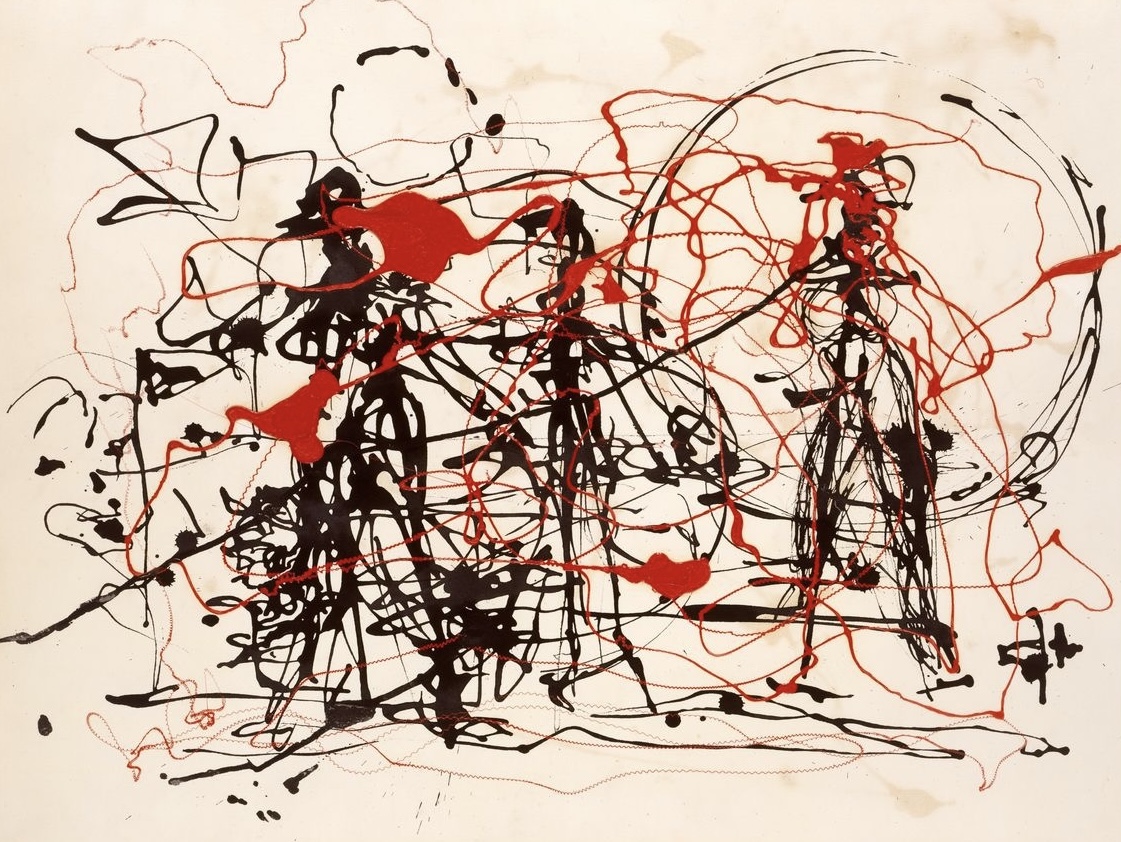
And then comes Jackson Pollock, who redefined rhythm entirely. In his drip paintings like Number 1A, 1948, rhythm is not observed — it is performed. Pollock’s gestures, movements, and drips translate bodily motion directly onto the canvas. The paint traces arcs of energy, looping, intersecting, and overlapping until chaos finds its own order. His rhythm is physical and instinctive, as if the painting itself has recorded the tempo of his movement.
Across these artists — from Van Gogh’s spirals to Matisse’s floating forms, from Mondrian’s balance to Monet’s flow and Pollock’s dance — rhythm becomes a universal language of movement within stillness. It connects the artist’s inner pulse to the viewer’s gaze, creating a silent dialogue of motion and emotion.
In the end, rhythm is what keeps a painting alive long after the paint has dried. It is the reason our eyes keep returning to a curve, a pattern, a line. It is the heartbeat of art — invisible, yet always felt.