

Claude Monet: Learning to See Again
When we look at a Monet, we often say it feels peaceful. Quiet ponds. Soft skies. Gentle light. But the story behind those canvases is far from quiet. It is a story of obsession, frustration, failing eyesight, rejection, persistence — and an artist who kept teaching himself how to see, again and again.
Monet did not begin as a celebrated master. In the 1860s and 1870s, he struggled financially and faced repeated rejection from the official Paris Salon. Critics dismissed his loose brushwork as unfinished, even careless. When he exhibited Impression, Sunrise in 1874, a reviewer mockingly called it merely an “impression.” The name stuck, but the ridicule was real. The hazy harbor, the vibrating orange sun, the blurred edges — all of it seemed radical, even improper, to audiences accustomed to polished historical scenes.
Yet Monet was not being careless. He was being truthful. Light does blur edges. Morning mist does dissolve form. Water refuses to sit still long enough to be neatly outlined. Instead of drawing rigid contours, he allowed color to build structure. Shadows became violet and blue. Surfaces shimmered. In Woman with a Parasol, the wind feels more alive than the figure herself. The canvas breathes with air.
What often surprises people is how disciplined he was. Monet painted the same subject repeatedly, sometimes working on multiple canvases in a single day to capture shifting light. The Haystacks were not about hay — they were about frost, sunset, snow, and mist. The stacks simply stood still while everything else changed. In the Rouen Cathedral series, even stone dissolves under different atmospheric conditions. Solidity becomes temporary.
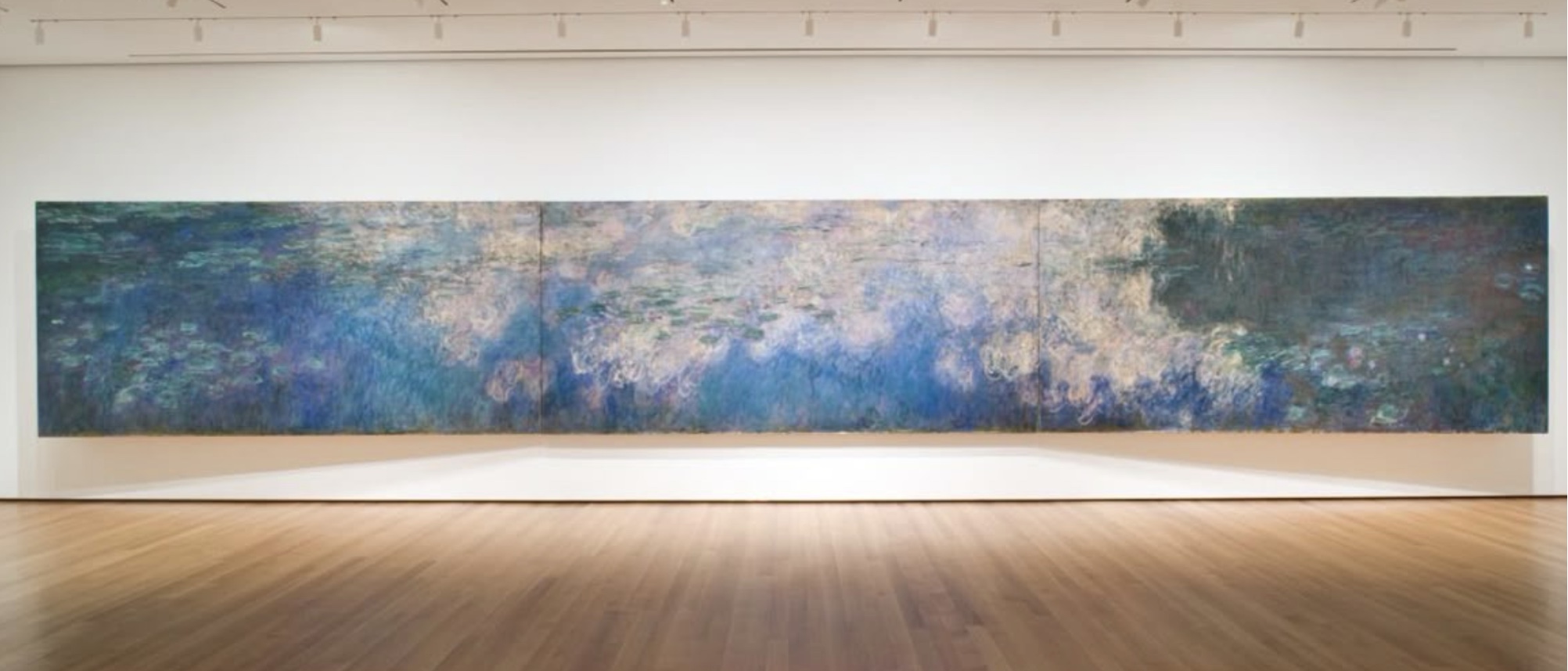
By the time Monet settled in Giverny, his garden became both refuge and laboratory. The water lily pond absorbed him completely. The vast panels of the Water Lilies feel immersive — horizon lines disappear, reflections blur sky and water into a single field of color. Many viewers describe them as serene, but they are also daring, pushing painting toward abstraction without announcing it.
And then came one of the most vulnerable chapters of his life.
In 1912, at the age of seventy-two, Monet was diagnosed with cataracts in both eyes. Colors dulled. Blues faded. The world grew reddish-yellow and clouded. For a painter whose life revolved around subtle chromatic shifts, this was devastating. He grew anxious and frustrated, often doubting the very canvases he was producing. Some he destroyed in anger. If we look at the works from this period — especially the later water lilies and willow paintings — we notice the change. The cool blue-greens give way to heavier reds, pinks, and ochres. Forms become more fluid, more abstract. He was not consciously abandoning representation; he was painting what he could see.
In 1923, Monet finally underwent cataract surgery on his right eye but refused to operate on the left. Afterward, his vision was uneven: through the treated eye he could once again perceive violets and blues, while the untreated eye still muted those tones. It is even believed that, because the natural lens filters ultraviolet light, its removal may have allowed him to perceive and paint wavelengths normally invisible to the human eye. Imagine the disorientation — and the strange gift — of seeing two different color worlds at once.
During these final years, Monet worked under immense physical and emotional strain. At times he questioned whether he should continue painting at all. Yet he persisted, completing the monumental Water Lilies panels that would later be installed at the Musée de l’Orangerie in Paris — a series he offered to France as a gesture of peace after World War I. The quiet expanses we see today were born out of uncertainty and endurance.
It is striking that this late recognition came after decades of dismissal. The artist who had once struggled to sell his work, who faced ridicule for his “unfinished” canvases, gradually became a central figure in modern art. By the time of his death in 1926, Monet was no longer the rebellious outsider. He was a master whose explorations of light had reshaped painting itself.
There is another detail that makes him feel close to us. Inspired by Charles-François Daubigny, who built a floating studio to paint rivers from within them, Monet constructed his own boat studio. He painted while gently rocking on water, immersed in reflections. It feels symbolic — an artist quite literally afloat inside his subject.
Monet’s life reminds us that art is not born from ease. It grows from persistence. From doubt. From the courage to continue even when vision — literal or metaphorical — falters.
In the end, Monet’s greatest subject was not lilies, cathedrals, or haystacks. It was perception itself — fragile, shifting, and deeply human.